

The problem
An agent doesn't reread what it thinks it knows
The store knows the current answer. If a fact changes, the old one is closed with a date and the new one is what a read returns. That part is in the first piece of this series.
An agent that already read still holds yesterday's answer in its chat, in its plan, in the next thing it writes. The store has the right answer, and nobody asks it again, because nobody knows there's something new to ask. I saw it with the pricing page. I told my agents to put the old text back in the Self-hosted column. Three days later I decided the opposite. The new decision sat in the store, and an agent that had read the first one carried on with it.
Between people it's the colleague who was at Monday's meeting and missed Wednesday's. The minutes were updated. He read them on Monday.
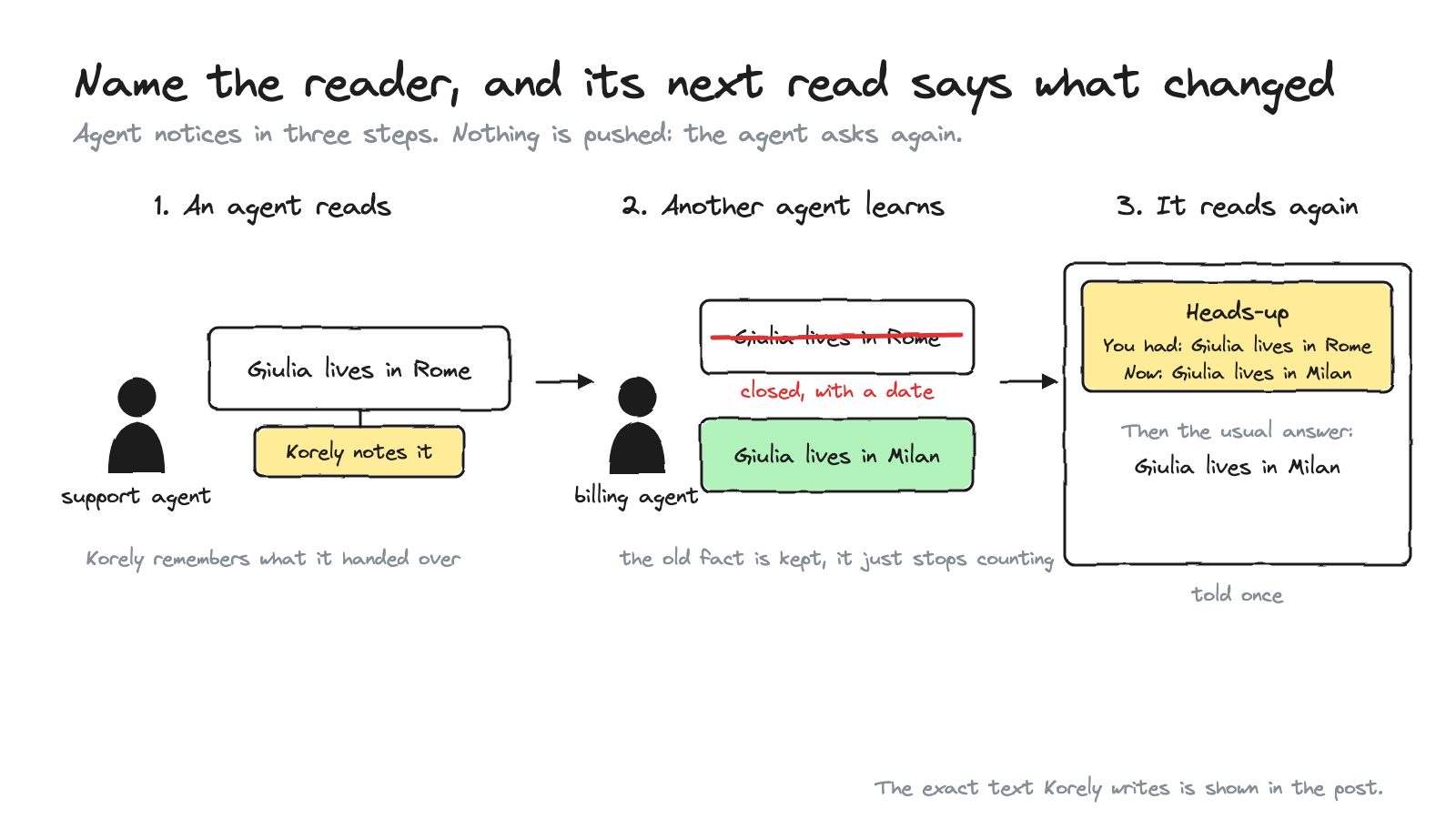
With agent notices, an agent tells Korely its name when it reads, and gets a heads-up at the top of its next context block when a fact it was handed has ended since. (The context block is the text Korely puts together for an agent before it answers: the facts that hold now, then the memories.) It works on the Cloud and in Self-hosted, the version you install yourself.
One thing to know first: this is pull, not push. Nothing wakes the agent or contacts it when a fact changes. The notice appears the next time that reader asks Korely for context.
How it works
Pass reader, the agent's own name
You add one parameter, reader, to GET /v1/context or
GET /v1/facts. Over MCP, korely_get_context and
korely_get_facts take it too.
curl -G https://api.korely.ai/v1/context \ -H "Authorization: Bearer kor_live_..." \ --data-urlencode "query=Where does Giulia live?" \ --data-urlencode "user_id=customer-giulia-4812" \ --data-urlencode "reader=support-bot"
The read returns what it returned before. Korely also starts remembering which facts it
handed to support-bot, with one small record per fact, a read mark. If one of
them ends, because another agent learned that Giulia moved, the next context read under the same name opens with a section like this before the known facts:
## Changed since you last read- was: The user lives_in Rome (since 2026-03-02) -> now: The user lives_in Milan (since 2026-11-10) (2026-11-10, read from a memory)- no longer true: The user uses Pro plan (since 2026-01-15) (2026-11-10, forgotten)A line says what the agent had and what holds now ("was ... now"), or only that it ended ("no longer true"). Then comes the day Korely learned of the change, and what ended the fact: a correction, a forget, a fact a caller stated, or, for every other closure, Korely's reading of a memory.
There are at most 3 lines per block, newest first, inside your token budget (the size you
allow the block). Each change is told at most once, even to two reads at the same moment. If more
than three have piled up, the rest are not lost: they wait for the next reads, and the REST
answer counts them in changed_more. The Agent notices page lists the extra
fields the REST answer carries.
reader is the stable name of whoever is told. Korely ties the marks to that
name, so two processes that use the same reader are one agent to it: a change
told to one is not told again to the other. Several copies of the same agent can share a
reader when you want one stream of notices. Different agents get different names, and
never a generic one like assistant, which another agent may use too. Give it
the name of an agent and never the id of an end user: an end user's erasure takes the marks
read under that end user's id.
Three labels are easy to mix up:
| Field | What it means |
|---|---|
user_id | The person the memory is about |
agent_id | On a write, the agent that wrote it. On a read, a filter: only what that agent wrote |
reader | The agent that is told what changed. It filters nothing: the read returns the same facts with it and without it |
One limit: a notice reaches an agent only when it reads again. Notices don't change a context already inside a model's prompt, so an agent that works for hours should read again before an important action.
A team's memory
Which changes a team hears
In a team's memory, where agents write with no end user, a notice is told by default when
somebody stated the change: a correction, a forget, or a fact a caller wrote. Add
changes=all to GET /v1/context or
korely_get_context and it tells the changes Korely worked out from notes too.
In the memory of an end user, every kind is told without asking.
So in a team, when a change matters, we correct the fact
(PATCH /v1/facts/{id}, or korely_correct_fact over MCP).
A correction ends the fact you name, and an agent that was handed it is told in its next
context block read under its name. The story of how we got there is in
how our own agents use it.
What we measured
In our delivery test, every recorded change was told once
We tried agent notices on the Cloud, with the real model. We made 12 changes, and the store closed 10 of the old facts. All 10 were told at the first read after, with the right cause, and no notice was told without a recorded change behind it. The other 2 were never closed, so there was nothing to tell: a notice is as good as the closure behind it.
That is a claim about delivery. Whether Korely was right to read two facts as a clash is a different question, because a model decides it, and the Known limits page has the numbers for that.
What it keeps
One row per fact, and no words
To tell an agent what changed, Korely remembers what it handed over: one small row for each fact a read gave to a named reader, with who read it, which fact, who the fact is about, and when it was first and last read. No text of a fact is kept, and only facts are marked, never memories.
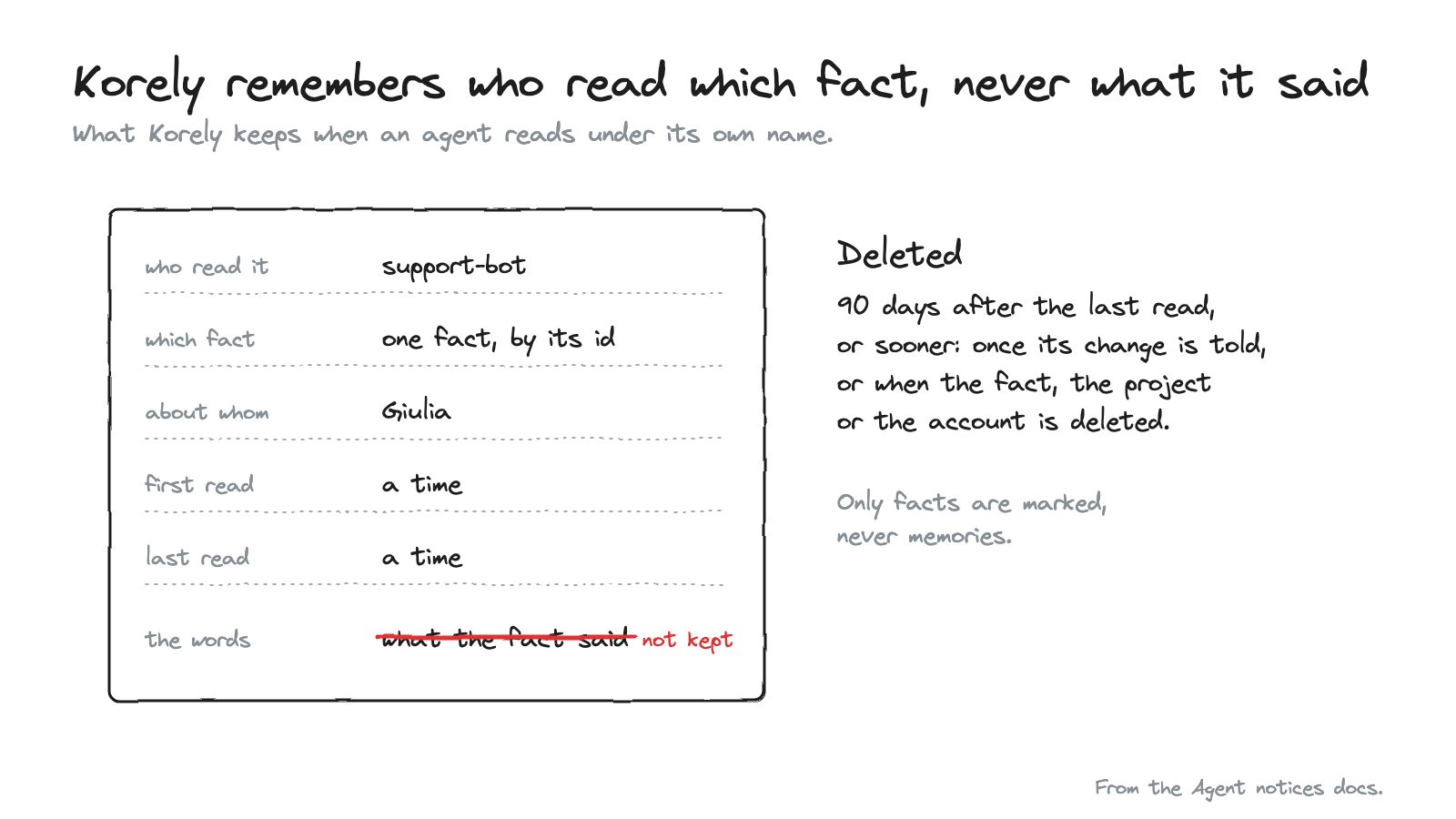
When a mark goes, and what takes it earlier, is on the Agent notices page and in Data & governance.
Back to the pricing page
One line, told once
When I changed my mind, the site changed with it: the list in the Self-hosted column now starts with a line about free code on GitHub. Picture that decision as a fact in our team's memory, and the coordinator correcting it instead of writing a new note.
Any agent that had been handed the old decision and asked again under its own name would get one line before the known facts: the old decision, then the new one. Then the rest of its context, as usual. On the read after that, nothing, because it has already been told.
Conclusions
What to take home
-
Pass the agent's name in
readerwhen it reads. At its next context read, it is told, at most once, which of the facts it was handed have ended since. - In a team's memory, correct a fact that matters instead of writing a new note next to it. A correction is a change somebody stated, and that's the kind a team hears by default.
To try it, add reader with your agent's name to the next context read of an
agent you already have. If you don't have one yet, the Quickstart walks
you to a key and a first write. Every field is on the Agent notices
page.
Read next
The rest of the series
- Shared agent memory: when several agents read the same facts. Where the sharing starts and where it stops.
- Multi-agent shared memory: how our own agents use it. The agents that help me build Korely keep their memory in Korely.
FAQ
Questions about agent notices
Does Korely push a change to the agent?
No. Nothing is pushed. The agent is told at its next context block, read with reader, its own name.
Does reader change what the agent reads?
No. reader names who is told; agent_id narrows what the block reads. Without reader every answer is the same as before, and Korely keeps no read mark (the audit trail records the read, as it does for every call).
What if more than three facts changed since the agent last read?
A block shows at most three changes, newest first. The others are not lost: they wait for the next reads, and the REST answer counts them in changed_more. If a writer keeps ending three or more of the facts an agent was handed before each of its reads, an older change can wait for a long time, and a very small token budget can leave no room for the section at all. For a decision that matters, read the fact itself.
Can two processes share one reader?
Yes, and Korely then treats them as one agent: a change told to one is not told again to the other. Give them the same reader if you want one stream of notices (several copies of the same agent), and different readers if each must hear every change.
What does Korely keep about a read, and for how long?
One row per fact the read handed over: the account, the project, the reader's name, the fact's id, the end user the fact is about, and the time of the first and last read. No text. It is deleted 90 days after the last read, or earlier: once its change has been told, or when its fact, its project, its account, its end user or that agent name is deleted.